The Miracle of the Sun

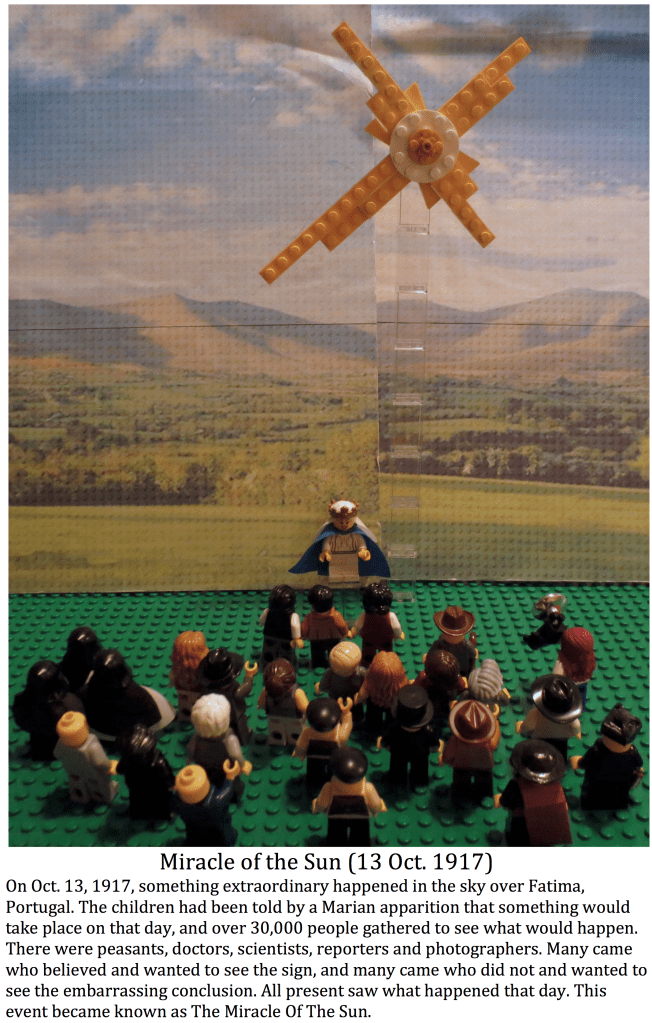
On Oct. 13, 1917, something extraordinary happened in the sky over Fatima, Portugal. The children had been told by a Marian apparition that something would take place on that day, and over 30k people gathered to see what would happen. There were peasants, doctors, scientists, reporters and photographers. Many came who believed and wanted to see the sign, and many came who did not and wanted to see the embarrassing conclusion. All present saw what happened that day. This event became known as The Miracle Of The Sun: https://www.youtube.com/watch?v=rBIs8cuIwTo

 Paul Glynn recounts the following in his book, Healing Fire of Christ: Reflections on Modern Miracles — Knock, Lourdes, Fatima:

One youth, who was to become Father Ignatius Pererira, sat in a village school about six miles away from Fatima. His teacher rushed out of the their classroom, followed by the pupils, when a roar went up from villagers outside the school. They stood transfixed, gaping at the antics of the sun, and most became terrified when it zigzagged and came plummeting down. He remembered one unbeliever who had earlier been jeering at the people going off to Fatima. He wrote, “Now he stood there as if paralyzed, stunned, staring at the heavens. I then saw him shake from head to foot, raise his hands to heaven and fall on his knees in the mud cry ing, ‘Holy Vrigin, Holy Virgin’.” This testimony appeared in Professor G. da Forseca’s 1943 book about Fatima

Joaquim Lourenco, who later became a priest and a canon lawyer in the diocese of Leiria, was a pupil at the same school He witnessed the sun spectacle with Pereira, their teacher and the whole school.  He and Pereira are featured in John Haffert’s book Meet the Witnesses, two of the two hundred witnesses personally interviewed by Haffert in the course of his research. (213)

One retorted that it was obviously a case of crowd hysteria and mass hallucination. However, Formigao pointed out that no one had been expecting a solar miracle; no one was even thinking about it. He was soon able to quote people in distant villages who saw the phenomenon independently of any links with the crowd. A number of these would eventually testify in print. A well-known Portuguese author, the Marquis de Cruz, published The Virgin of Fatima in 1937. He first quoted eye-witnesses who were at Fatima on October 13… Then he quoted “the brilliant poet Alfonso Lopes Viera”, with whom he visited the evening of October 30, 1935, on the balcony of the poet’s home in San Pedro der Muel, thirty miles from Fatima. “On October 13, 1917, I had forgotten about the prediction of the three shepherd children when I was surprised and charmed by a spectacle in the skies”, Viera told de Cruz. “It was truly astounding, and I’ve never so much as heard of anything similar to what I watched from this balcony.” (214)

…and so on. There’s more, but that should suffice to demonstrate that something did happen in the sky that was visible  not only from within the crowd but also for many miles around.  If you want more info, I suppose you could either grab that book or start tracking down the accounts I’ve reprinted here.

It’s important to remember as well that there was a miracle predicted for noon, but it was never said it would involve the sun or be in the sky, so nobody would have had a reason to be watching for it who was not present in the crowd when the word went out saying, “Look at the sun!”  Also, the miracle happened at 1:30, but Portugal turned the clocks an hour forward on account of the war by an hour and a half, so it did occur at proper (solar) noon even though it was late by people’s watches.

Happy Birthday Mother Cabrini

St. Frances Cabrini was born on 15 July 1850 in Italy. She founded an order (The Missionary Sisters of the Sacred Heart of Jesus) with the intention of evangelizing China. When she sought the permission of Pope Leo XIII, however, he told her she would go “not to the East, but to the West.” Her first stop was New York, where she and her sisters ministered to the Italian immigrants who had little support for their faith in the predominantly Protestant United States.

By the end of her life, her missionary work had taken her to establish sixty-seven institutions throughout the United States, Central America, and South America. Today, the Missionary Sisters of the Sacred Heart of Jesus is established in seventeen countries on six continents. Mother Cabrini died in 1917. She was canonized in 1946 and named the Patroness of Immigrants in 1950.

You can learn more about St. Frances Cabrini here.

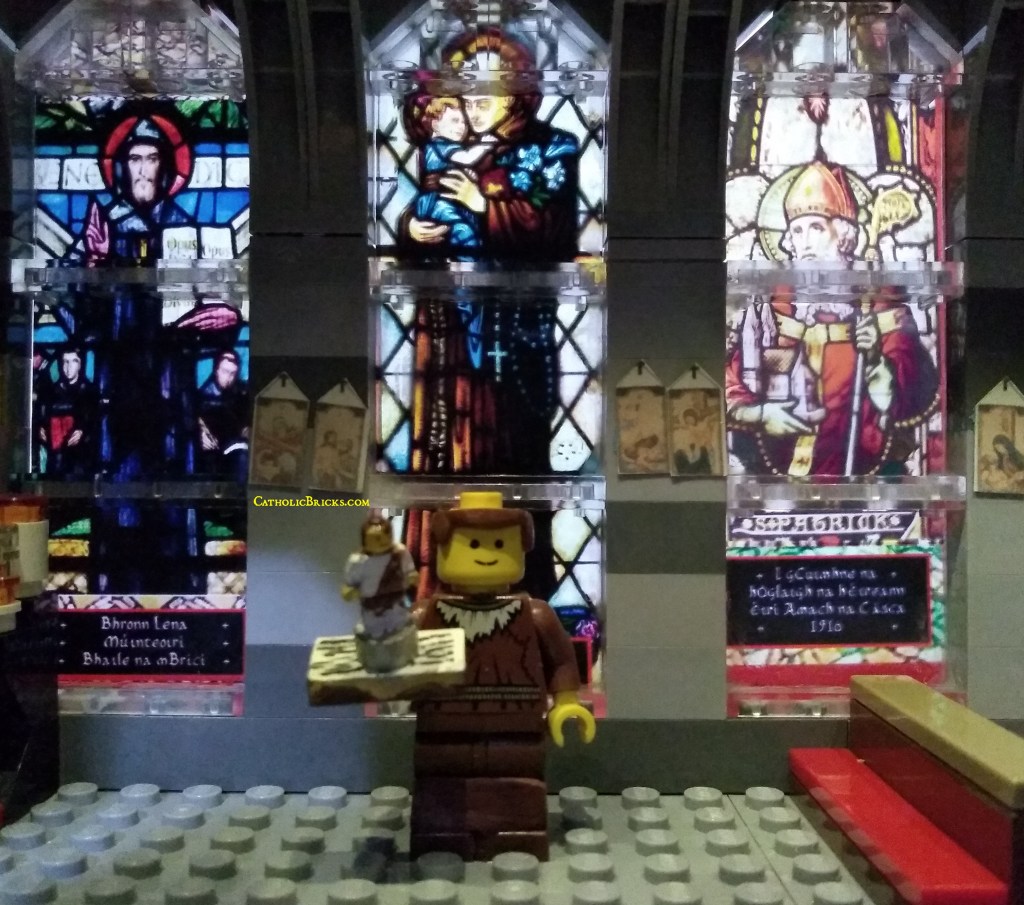
St. Anthony of Padua (June 13)

St. Anthony of Padua (1195-1231). Feast Day: June 13.

Born Fernando Martins de Bulhões in Lisbon, where he would enter an Augustinian order, St. Anthony would eventually leave them for the Franciscans shortly after becoming a priest. He modeled his spiritual life after St. Anthony of Egypt, and had hoped to die a martyr in North Africa. He was eventually sent to Morocco, but he was not killed, so he returned and remained in Italy, preaching and teaching.

St. Anthony was renowned for his preaching skills. In early art, he was depicted with a Bible and a small figure of Jesus on the pages — legend has it that he was so good at understanding and explaining scripture because Jesus himself would appear in order to explain it to him during his study times.

Over time, the figure of Jesus was made larger and larger until it was about the size of a child, at which time the artists began to depict the Jesus figure as the child Jesus, standing or sitting on the book held by St. Anthony, while the Saint embraced him lovingly.

St. Anthony is a Doctor of the Church, an incorruptible saint (you can see his tongue on display to this day, and is the patron saint of those seeking to find lost articles.

Feast of Corpus Christi

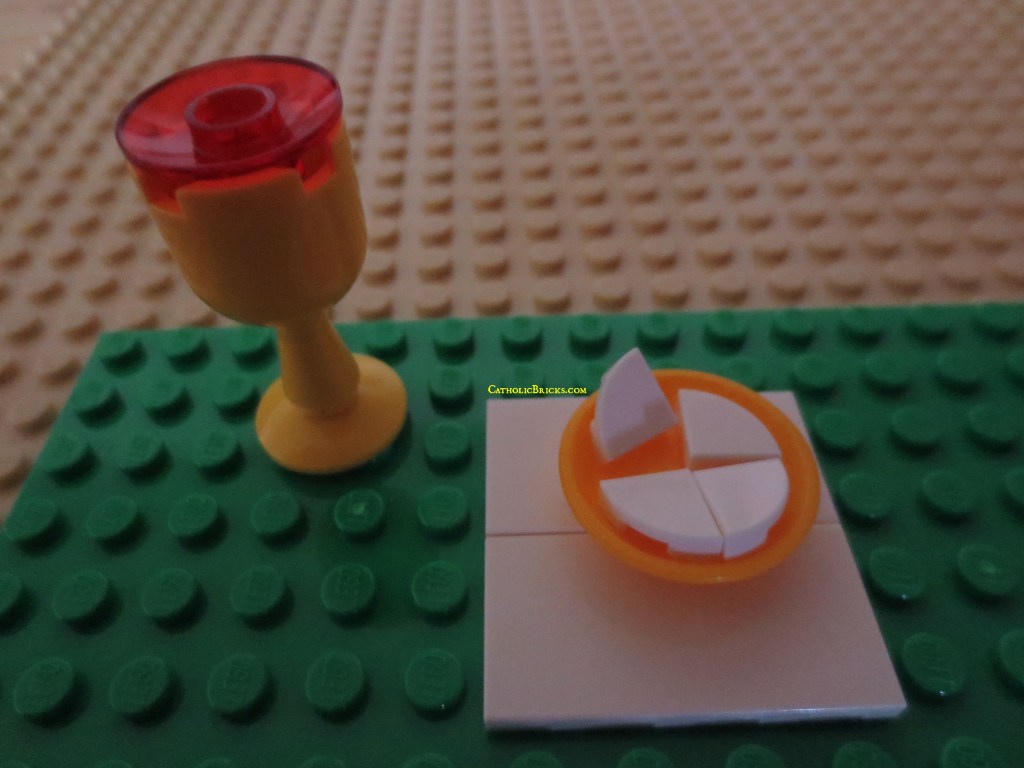
The “Bread of Life Discourse” in John 6 is crucial for all Christians to understand (as it was for the first Christians). Prior to verse 6:54, Jesus used the word φαγειν for “to eat.” In 6:54, 56, and 57, Jesus becomes even more emphatic and literal, when he changes the term used for “to eat” to τρωγων which would be most accurately translated as “to gnaw” or “to chew.” He used the most visceral and literal term for what He meant.  He further doubled-down on the literalness of what he meant with the term αληΘως, that is “truly,” regarding his flesh being literal food and his blood being literal drink in 6:55.

The earliest Christians understood the literalness of Jesus’s words, and practiced the faith accordingly.  We know this, because they left detailed accounts of their practices behind.

In AD 155, St. Justin Martyr wrote what came to be called his “First Apology.”   In it, he explains the Christian faith to the pagan Emperor Antonius Pius.  Scholars believe that Justin was personally taught the faith by the Apostle John himself.  When it comes to the early Christian belief about the Body and Blood of Jesus, he says the following:

“And this food is called among us Εὐχαριστία [i.e. the Eucharist], of which no one is allowed to partake but the man who believes that the things which we teach are true, and who has been washed with the washing that is for the remission of sins, and unto regeneration [i.e. baptized], and who is so living as Christ has enjoined [i.e.in a state of grace]. For not as common bread and common drink do we receive these; but in like manner as Jesus Christ our Savior, having been made flesh by the Word of God, had both flesh and blood for our salvation, so likewise have we been taught that the food which is blessed by the prayer of His word, and from which our blood and flesh by transmutation are nourished, is the flesh and blood of that Jesus who was made flesh [i.e. transubstantiation]. …And when the presider [i.e. the priest] has given thanks, and all the people have expressed their assent, those who are called by us “deacons” give to each of those present to partake of the bread and wine mixed with water over which the thanksgiving was pronounced, and to those who are absent they carry away a portion [i.e. implying that a permanent change had taken place at the consecration and that the bread and wine were more than a mere symbol].”

While Catholics do not subscribe to Sola Scripture, it would seem that those who do and are most intent at finding application for the most literal rendering of scripture without external traditions imparting to it the un-literal, as well as those most intent on “reclaiming” the earliest Christian practice, should necessarily both subscribe to the Catholic (and Eastern Orthodox) understanding of the role and nature of the Eucharist in Christian worship.

Jesus’s audience knew well that He meant that his flesh was literally food and his blood was literally drink and that He expected them to literally eat and drink of it as such.  They understood this so well, that they walked away from Him and refused to follow Him after this teaching.  If Jesus had been speaking figuratively, when He saw that they were offended by taking Him literally, He would have corrected them. Instead, He lets them walk away because He knows that they understood His literal teaching correctly and chose to reject it.

Likewise, there is an important lesson in Peter’s words for those who struggle with the human imperfections that are a part of the Church that Christ instituted.  Whether we struggle with a teaching that offends our modern sensibilities, struggle to reconcile the Church’s moral authority in light of immoral scandals, or struggle to swallow our pride when we don’t like priests/homilies/music/decor/etc, we must remember that it is only within Holy Mother Church that we have access to the sacraments (like the Eucharist), and it is through the sacraments that God prefers to impart His grace to us.  If we walk away from Christ’s Church, we necessarily walk away from God’s Sacraments and the grace they permit us to access.  A Christian who truly understands Christ’s Real Presence in the Eucharist could never walk away from the Catholic Church, for if he did, “to whom should he go?”